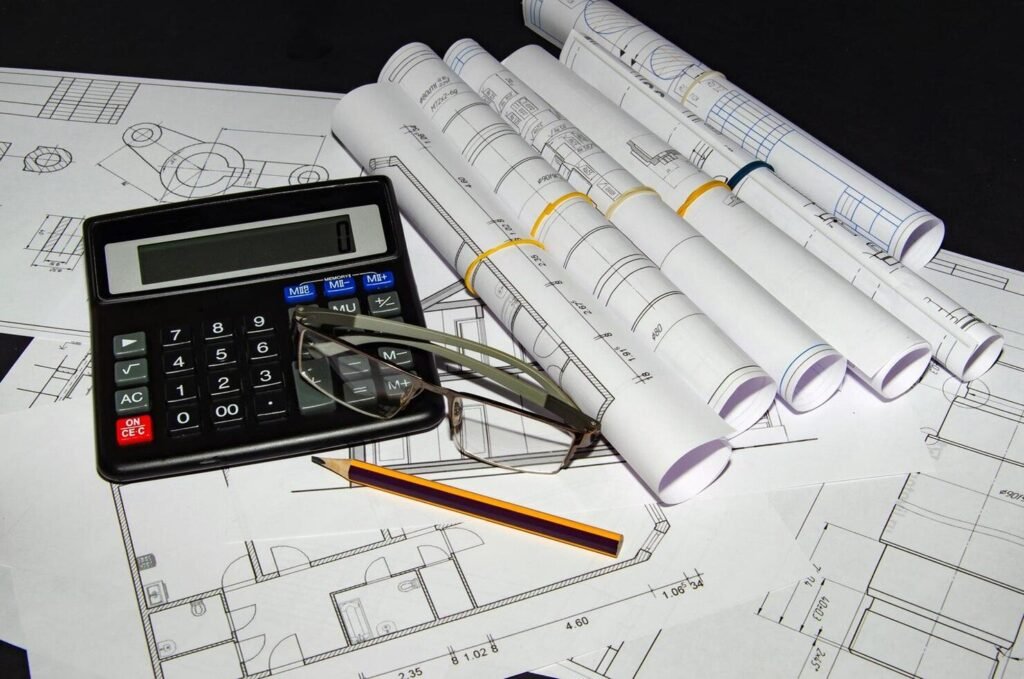
A Bill of Quantities, often shortened to BOQ, is a document that lists every item of work in a building project. Each line has a short description, a unit of measurement and a quantity. Contractors add their rates to those lines, and the total becomes their tender price. Some people search for bills of quantity in the singular. The usual UK term is Bill of Quantities, but both mean the same document.
At COMET Estimating LTD we work with Bill of Quantities documents every week. We are a UK estimating company with our head office in London, and we deal with contractors, builders and homeowners across England, Scotland, Wales and Northern Ireland. This guide is based on how BOQs are actually prepared and priced on UK jobs.
What is a Bill of Quantities?
A Bill of Quantities is a measured list of all the work needed to build a project. A quantity surveyor (QS) reads the drawings and the specification, measures everything, and writes it up item by item. The finished document goes out to contractors at the tender stage, with the rate and amount columns left blank.
Here is the simple idea behind it. Give the same drawings to five contractors and each one will measure the job in their own way. You end up with five prices built on five different sets of quantities, and they are very hard to compare. With a Bill of Quantity, all five contractors price the same items in the same quantities. The only thing that changes is the rate they put against each line.
A BOQ is not a shopping list of materials. It describes finished work, for example brickwork measured in square metres or concrete measured in cubic metres. The rate a contractor enters for each item normally covers labour, materials, plant, overheads and profit together.
What does a Bill of Quantities include?
Every BOQ looks a little different, but most UK documents follow the same layout:
- Preliminaries: costs that apply to the whole job, such as site setup, supervision, welfare cabins, scaffolding, insurance and site security.
- Measured work: the main part of the document. Items are grouped by trade or work section, like groundworks, concrete, masonry, roofing, windows, finishes and services.
- Provisional sums: money set aside for work that cannot be fully defined at tender stage.
- Prime cost (PC) sums: allowances for items the client will choose later, or work done by a nominated supplier. Contractors then add their own profit and attendance on top.
- Dayworks: hourly or daily rates for small jobs that cannot be measured and are paid for by time.
- Summary or collection: the totals from each section, carried to one page. This gives the final tender sum.
Bill of Quantities example
Below is a short extract from an unpriced BOQ for concrete work. The figures are for illustration only. The contractor fills in the rate and amount columns.
| Item | Description | Unit | Qty | Rate | Amount |
| A | Plain in-situ concrete, C25/30, in foundations, poured against earth | m³ | 42 | | |
| B | Reinforced in-situ concrete, C32/40, in ground floor slab, 200 mm thick | m³ | 85 | | |
| C | Formwork to sides of foundations, height not exceeding 500 mm | m | 120 | | |
| D | Mesh reinforcement, A393, in ground floor slab, 200 mm side laps | m² | 430 | | |
Notice how each line is clear enough to price without guessing. The type of concrete, where it goes and the thickness are all stated. Anything longer, like full material standards, stays in the specification and the BOQ simply points to it.
Who prepares a Bill of Quantities, and who prices it?
On a traditional UK project, the client’s quantity surveyor prepares the Bill of Quantities once the design is mostly complete. A cost consultant or a specialist estimating firm can also do the work. The BOQ is issued with the tender documents, and each contractor’s estimator then prices it.
So the split is simple. The QS measures and describes the work. The contractor’s estimator puts the rates on it. Once a contractor is appointed, the priced BOQ usually becomes part of the contract.
We would not suggest that a homeowner writes one alone. A BOQ has to be precise, and a missing item can turn into a costly extra later.
Types of Bill of Quantities
| Type | What it means | When it is used |
| Firm BOQ | Measured from a complete design, so quantities are treated as accurate | Traditional tenders with finished drawings |
| Approximate BOQ | Based on an unfinished design, then remeasured as the work is done | Early tenders and civil engineering |
| Unpriced BOQ | Issued to tenderers with blank rates | Tender stage |
| Priced BOQ | Returned with the contractor’s rates filled in | Tender comparison and the contract |
| Work section (trade) BOQ | Items grouped by trade | The most common format in the UK |
| Elemental BOQ | Items grouped by building element, like substructure, frame and roof | Cost planning and project comparison |
UK rules of measurement for a Bill of Quantities
A BOQ only works when everyone measures in the same way. In the UK, that comes down to a few standard documents:
- NRM2: the RICS New Rules of Measurement, detailed measurement for building works. It is the standard used to prepare a Bill of Quantities for building projects.
- SMM7: the older Standard Method of Measurement. NRM2 replaced it in January 2013, although you may still see SMM7 on older documents.
- NRM1: covers cost estimating and cost planning. It is used before a BOQ exists, and early budgets like this are covered by our Preliminary Estimating Services.
- CESMM4: the Civil Engineering Standard Method of Measurement, normally used on civil engineering projects instead of NRM2.
Which UK contracts use a Bill of Quantities?
Not every contract needs one. The JCT Standard Building Contract With Quantities uses a priced BOQ as a contract document, and the rates are used to value variations. The Without Quantities version relies on drawings and a specification or schedule of works, so contractors measure their own quantities. Design and Build contracts normally do not use a client BOQ either, because the contractor is responsible for the design.
On remeasurement contracts, which are common in civil engineering, an approximate BOQ is used and the quantities are measured again as the work goes on.
Bill of Quantities vs schedule of works, BOM and quantity takeoff
These documents get mixed up all the time. Here is how they differ:
| Document | What it is | Who uses it |
| Bill of Quantities | Every item measured, described and listed in a standard format | QS and tendering contractors |
| Schedule of works | A written list of the work to be done, with no detailed measured quantities | Smaller jobs, homeowners, small builders |
| Bill of materials (BOM) | The materials to buy, in purchase units like bags, sheets and lengths | Buyers and site teams |
| Quantity takeoff (taking off) | The raw measurements taken from drawings or a model | QS and estimators, before the BOQ or estimate |
In short, the takeoff gives the measurements, the BOQ turns them into a formal pricing document, and the BOM helps with buying materials after the contract is awarded. You can see how we handle measurement on our Construction Takeoff Services page.
Do you need a Bill of Quantities?
A Bill of Quantities is most useful when the job is big enough that price differences between contractors would be hard to explain. Use this quick checklist.
You probably need a BOQ if:
- the project is large or complex
- several contractors are tendering and you want a fair comparison
- the contract is JCT Standard Building Contract With Quantities
- you want a clear basis for valuing variations and interim payments
- it is a public sector job where fair tendering is expected
You can probably skip it if:
- it is a small extension, loft conversion or minor alteration
- one trusted contractor is pricing the work
- the project is design and build
- a schedule of works with good drawings covers everything
Benefits of a Bill of Quantities
- Fair tender comparison. Every contractor prices the same scope and quantities.
- Better cost control. You can see which items cost the most, which helps when you need to save money. A costly insulation choice, for example, stands out on its own line instead of hiding inside a lump sum.
- Easier variations. When the scope changes, the original rates give a starting point for the new value.
- Fewer arguments. Clear descriptions leave less room for disagreement on what was and was not included.
There are limits too. A BOQ needs a fairly complete design, it takes time and money to prepare, and any mistakes in it can be passed straight into the contract price.
Common Bill of Quantities mistakes
- Missing items: work shown on the drawings but left out of the bill. Contractors either guess a price or claim it later as a variation.
- Vague descriptions: items that can be read in more than one way, which makes tender comparison unfair.
- Weak preliminaries: scaffolding, temporary works and site costs described poorly, then claimed back later.
- Measuring from incomplete drawings: a firm BOQ built on unfinished design usually ends up needing a lot of remeasurement.
- Mixed measurement rules: one section measured to NRM2 and another to a different method.
- No audit trail: quantities that cannot be traced back to the drawings.
Most of these problems start at the takeoff stage. Careful, well-recorded measurement is what makes a Bill of Quantity reliable.
How much does a Bill of Quantities cost, and how long does it take?
There is no single price. The cost depends on the size of the project, the number of trades, how complete the drawings are and which measurement rules apply. A small fit-out can take a week or two to measure and write up. A large multi-storey job can take several weeks. An unfinished design adds time and risk, because the quantities may change.
To give an accurate quote, an estimator will want the drawings, the specification, any schedules and the contract type. At COMET Estimating LTD we aim to return estimates quickly, often within one to two business days on smaller packages, and we confirm timing once we have seen your documents.
How COMET Estimating LTD can help
Our team prepares quantities, takeoffs and cost information for UK building projects across more than 20 trades. If you need pricing support alongside your BOQ, take a look at our construction estimating services. If your project is a building job and you want a full cost breakdown, our building estimating services page explains how we work and what we need from you.
You can also visit the COMET Estimating LTD home page to see our other services, or get in touch with your drawings for a free look at your scope.
Conclusion
A Bill of Quantities gives everyone the same starting point. Clients get fair tender prices, contractors know exactly what to price, and both sides have a clear record to work from once the job starts. It will not suit every project, but on larger or more complex UK jobs it is one of the most useful documents you can have.